
A language model is only one part of a medical answer system. The workflow around the model can change how it searches, reviews, and presents evidence. We tested that idea across five model families on HealthBench Hard, a deliberately challenging subset of the broader HealthBench benchmark.
The same bounded CliniAtlas workflow increased the mean score for every tested model. The observed gains ranged from 5.76 to 19.62 percentage points. The result was consistent at the model level, but it was not uniform across tasks or prompts.
- 5 of 5
- models improved on the mean score
- +5.76 to +19.62 pp
- observed length-adjusted gain
- 100 cases
- locked HealthBench Hard cohort
What we tested
HealthBench contains 5,000 realistic, multi-turn health conversations. HealthBench Hard is the 1,000-example subset that frontier models found most challenging. We used a locked 100-case development cohort from that subset. For exploratory subgroup analysis, we grouped those cases into 50 medical research tasks, 25 care consult tasks, and 25 writing and documentation tasks.
Each model answered every case in two matched arms. The direct arm used one model call without tools or a system prompt. The CliniAtlas arm used the complete three-pass workflow. The same model completed all workflow stages. GPT-5.4 judged both answers with the benchmark rubrics. A generation or grading failure received a score of zero.
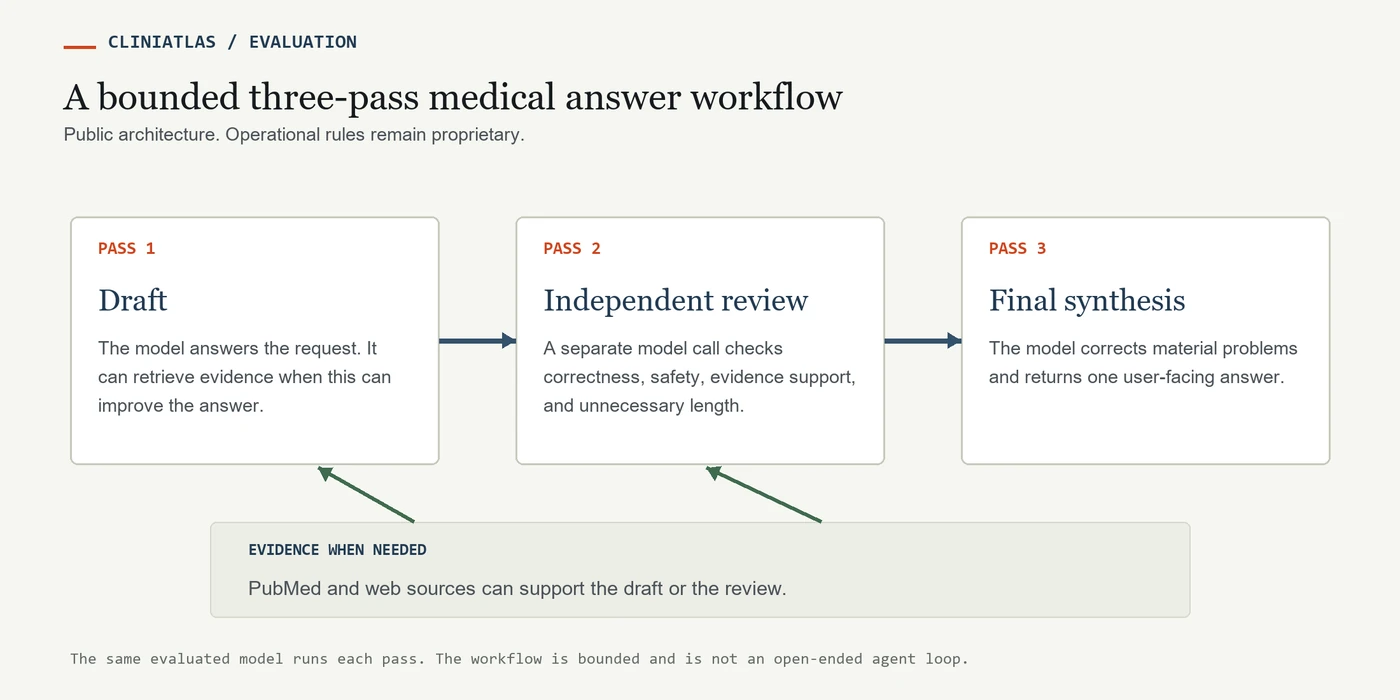
How the three passes work
Pass 1 creates a complete draft. It can retrieve evidence when the question needs current or source-specific information. Pass 2 reviews the draft in a separate model call. It checks clinical correctness, evidence use, completeness, and clarity.
The workflow can run a small investigation when the review finds a narrow gap. Pass 3 then receives the draft, review, and collected evidence. It corrects material problems and produces the final answer.
This is an end-to-end product comparison. The workflow arm used more test-time compute and a larger answer budget than the direct arm.
The result across five models
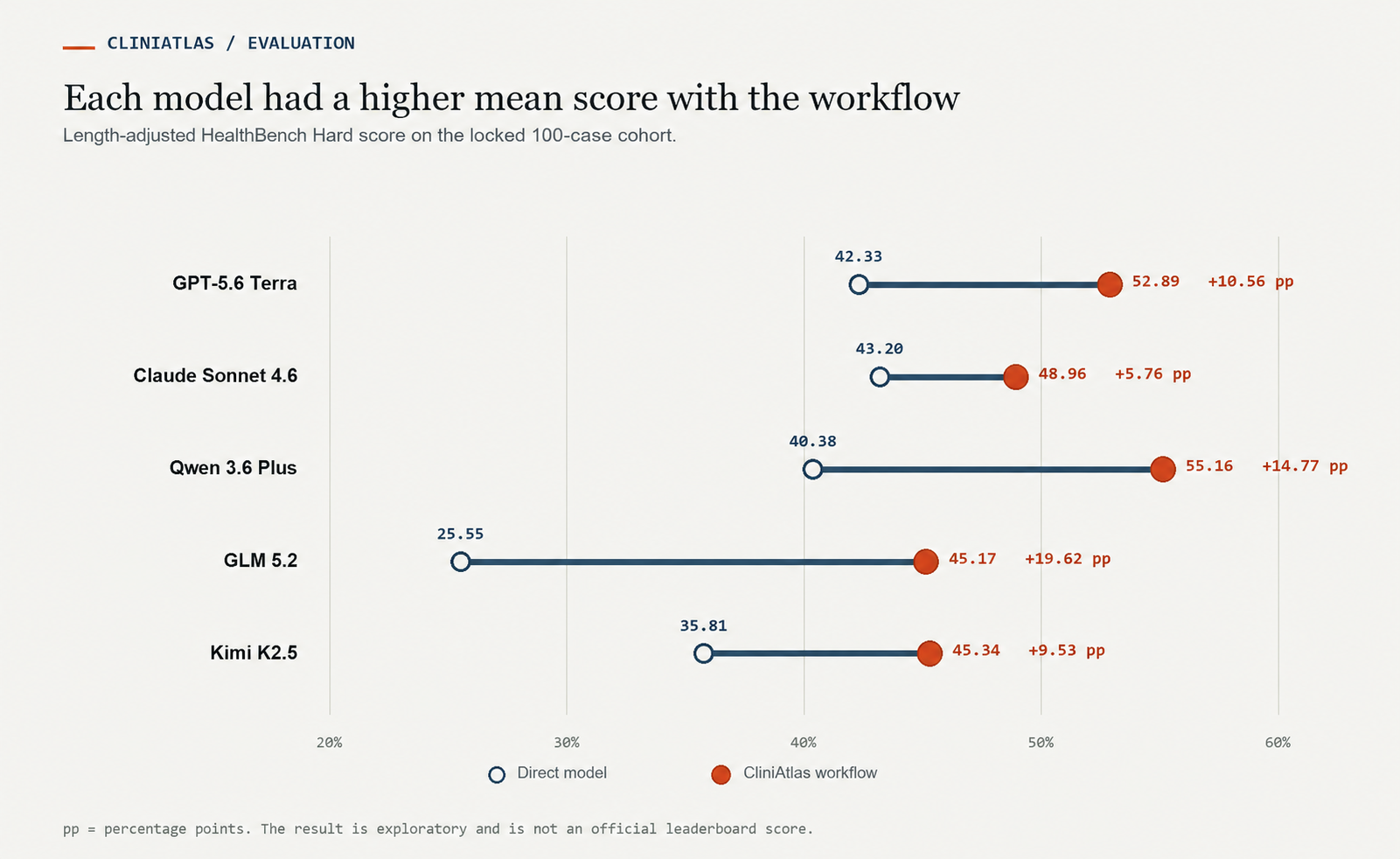
GLM 5.2 had the largest observed gain at 19.62 percentage points. Qwen 3.6 Plus gained 14.77 points. GPT-5.6 Terra gained 10.56 points. Kimi K2.5 gained 9.53 points. Claude Sonnet 4.6 gained 5.76 points.
The starting score did not fully determine the gain. GLM had the lowest direct score and the largest gain, but the other models did not follow one simple rank order.
The task changed the size of the gain
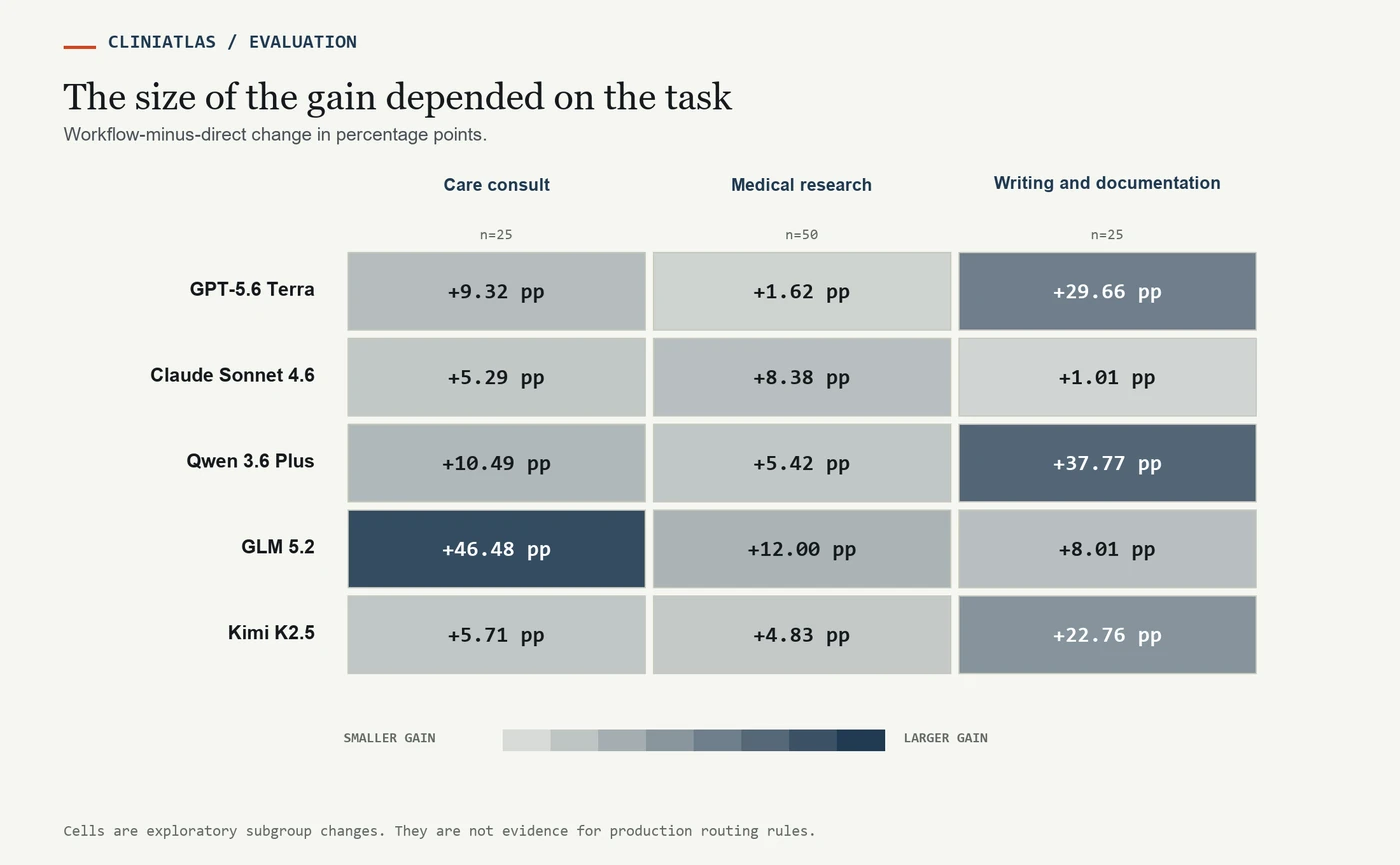
GPT-5.6 Terra, Qwen 3.6 Plus, and Kimi K2.5 improved most on writing and documentation tasks. Claude Sonnet 4.6 improved most on medical research tasks. GLM 5.2 improved most on care consult tasks. These smaller cells help us form testable hypotheses for the next evaluation.
A higher mean did not mean that every answer improved
Claude Sonnet 4.6 won 48 prompt-level comparisons and lost 52. Its mean score still increased by 5.76 points because its improvements were larger on average than its regressions. Kimi K2.5 won 78 cases, tied one, and lost 21. It also had five workflow execution failures.
The complete-pair sensitivity analysis kept the same direction and a similar size of change. Kimi gained 10.22 points on the 95 pairs without an execution error, compared with 9.53 points in the primary analysis. Quality and execution reliability remain separate product goals.
The score gain was not only a length effect
Raw scores increased for all five models. Four workflow arms also produced shorter answers on average. Kimi K2.5 was shorter by 1,623 characters, Qwen 3.6 Plus by 1,055, GPT-5.6 Terra by 871, and Claude Sonnet 4.6 by 44. GLM 5.2 was longer by 57 characters.
A shorter answer is not automatically better. It must keep the information that the reader needs. These data only show that the observed gains did not come from making every answer longer.
A transparent evaluation with a versioned implementation
We publish the cohort definition, evaluation conditions, score rule, failure policy, aggregate results, subgroup results, and main limitations. This gives readers enough information to assess the result.
The production three-pass prompts, typed contracts, routing integration, and orchestration code are versioned with the CliniAtlas application. We do not publish private user data, credentials, hidden model reasoning, raw reviewer traces, benchmark reference answers, or other protected evaluation material. Selected technical records can be shared with research partners under controlled review.